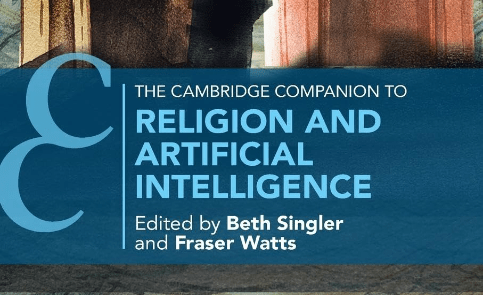
Wesley Wildman and I have a chapter on “Simulating Religion” in the just published Cambridge Compantion to Religion and Artificial Intelligence, edited by Beth Singler and Fraser Watts.
Here are the first two paragraphs from our chapter:
In recent years there has been a significant growth in the use of computer models to study complex social systems, including ‘religious’ systems, in the social sciences and humanities. This approach enables scholars to analyze and explain connections between factors at various levels that influence the increase (or decrease) of religiosity in human minds and culture. Models that simulate religious phenomena can include salient variables at the micro-level (e.g., strength of personal belief in God), the meso-level (e.g., access to ritual participation), and the macro-level (e.g., state support or oppression of religious coalitions). The most popular approach in the rapidly expanding field of computational science of religion is Agent Based Models (ABMs), in which simulated religious (or non-religious) agents interact with one another and their environment in an ‘artificial society’. Another common approach is System Dynamics Models (SDMs), in which the causal relations among system level variables (rather than individual agents) are simulated and explored. This chapter provides examples of both types of models and outlines some of the philosophical issues associated with using these computational tools in the scientific study of religion.
But what does any of this have to do with the broader topic of this book? What does computational modeling and simulation of religion have to do with artificial intelligence (AI)? The latter typically evokes images of a machine that can simulate human or human-like intelligence, able to learn and complete—and maybe outperform individual humans in—tasks such as playing chess, calculating, or processing information. That image of AI does apply in ABMs when the agents have sophisticated cognitive and learning abilities. In this context, however, we are also interested in two other ways of thinking about AI in relation to simulating religion. On the one hand, we consider the way AI functions within artificial societies composed of heterogeneous agents, something ABMs are well suited to explore. Real human intelligence, like real human religiosity, emerges in a dynamic social context and social simulations enable scholars of religion to account for these environmental factors as well as the individual differences among religious agents and groups. On the other hand, we also consider the way a complex dynamical reality—say, an individual mind, an organization, or a society—can be intelligently expressed as a computational system, something SDMs are well suited to explore. ABMs help us focus more on the way system-level properties emerge from lower levels, whereas SDMs help us focus more on the non-linear dynamics of an intelligent system, including reinforcing and dampening loops and interaction effects. The ABM technology gives us a way to study the individual behavior of intelligent agents and the emergent effects of networks of such agents; the SDM technology uncovers the ‘internal intelligent dynamics’ of a complex system, including human minds and social systems.
 F. LeRon Shults